
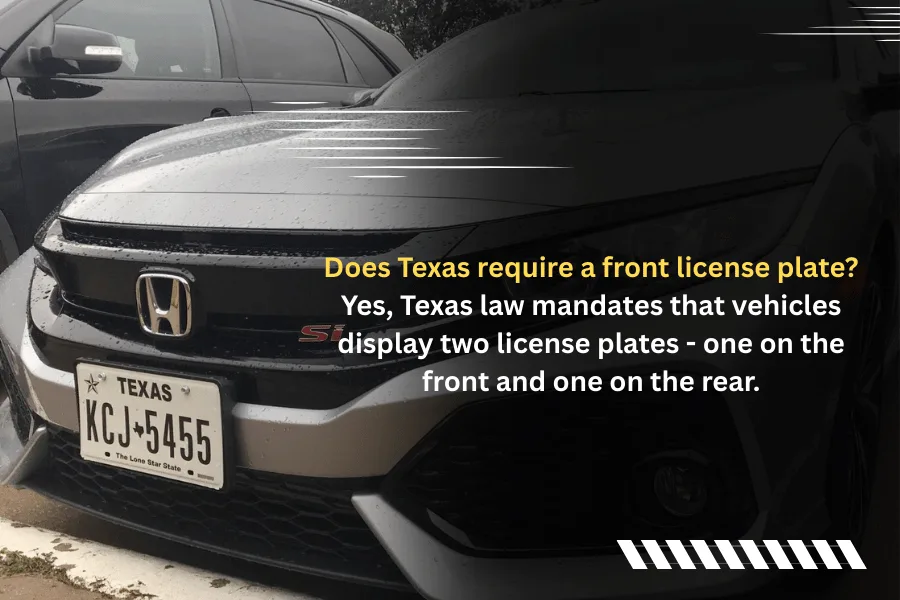
Does Texas require a front license plate in 2026? Yes, Texas law mandates that vehicles display two license plates – one on the front and one on the rear. This requirement applies to most passenger vehicles, trucks, and commercial vehicles registered in the Lone Star State. Drivers who fail to display both plates face citations and fines, despite common misconceptions and frequent violations.
This comprehensive guide explains Texas front license plate laws, enforcement practices, penalties, exemptions, and practical considerations for complying with state requirements.
Must Read: Is a Radar Detector Illegal in Houston Texas
Texas Transportation Code License Plate Requirements
Texas Transportation Code Section 504.943 establishes the two-plate requirement explicitly. The statute leaves little room for interpretation regarding front plate obligations.
Legal Requirements:
- Two license plates must be displayed on most vehicles
- Front plate mounted on front exterior in designated location
- Rear plate mounted on rear exterior in designated location
- Both plates must be clearly visible and legible
- Plates must remain unobstructed by covers, frames, or accessories
Texas Department of Motor Vehicles issues two license plates with every standard vehicle registration. This practice reflects the state’s two-plate requirement.
Specific Statutory Language
Texas Transportation Code Section 504.943 states: “The owner of a vehicle, other than a trailer, semitrailer, or pole trailer, shall display the license plates on the front exterior and rear exterior of the vehicle.”
This clear directive eliminates ambiguity. Texas explicitly requires front plate display for covered vehicles. The statute’s plain language confirms the two-plate mandate.
Legislative History:
Texas has maintained the two-plate requirement since implementing modern vehicle registration systems. Multiple legislative sessions have considered eliminating the front plate mandate but consistently rejected such changes.
Most recent attempts to remove front plate requirements occurred in 2017 and 2019 legislative sessions. Both efforts failed to advance beyond committee stages despite support from vehicle enthusiasts and aesthetic-minded drivers.
Vehicles Subject to Front Plate Requirements
The two-plate requirement covers most vehicles registered in Texas but includes important exemptions and special categories.
Standard Passenger Vehicles
Covered Vehicle Types:
- Sedans and coupes of all sizes
- SUVs and crossover vehicles
- Minivans and passenger vans
- Station wagons and hatchbacks
- Most pickup trucks registered as passenger vehicles
Texas registration documents for these vehicles include two license plates. Owners must display both plates to comply with state law.
Motorcycles and Trailers Exempted
Single-Plate Exemptions:
- Motorcycles (rear plate only)
- Trailers of all types
- Semitrailers used in commercial operations
- Pole trailers for specialized hauling
- Road tractors without cargo space
These vehicles receive single plates from Texas DMV. The exemption reflects practical mounting limitations on motorcycles and trailer designs.
Commercial Vehicles and Trucks
Commercial trucks and vehicles registered for business purposes follow the same two-plate requirement as passenger vehicles. No commercial exemption exists for front plate display.
Commercial Vehicle Requirements:
- Straight trucks displaying two plates
- Delivery vans showing front and rear plates
- Box trucks with both plates visible
- Service vehicles maintaining two-plate compliance
- Fleet vehicles following standard requirements
Businesses operating vehicles in Texas must ensure all units display required front plates regardless of aesthetic preferences or branding concerns.
Penalties and Enforcement for Missing Front Plates
Texas law enforcement agencies actively cite drivers for missing front license plates. The violation carries specific penalties and potential complications.
Citation and Fine Structure
Primary Violation Penalties:
- Class C misdemeanor offense
- Fine up to $200 maximum
- Court costs adding $70-100 typically
- Total violation cost: $150-300 average
- No jail time for plate violations alone
Officers can issue citations specifically for front plate violations. This represents a primary offense allowing stops solely for missing front plates.
Traffic Stop Authority:
Texas law permits officers to initiate traffic stops when they observe vehicles missing front license plates. The missing plate provides probable cause for the stop even without other violations.
This authority means drivers without front plates risk stops that may reveal other violations like expired registration, insurance lapses, or warrant checks.
Multiple Violation Scenarios
Compounding Penalties:
Missing front plates often compound with related violations:
- Expired registration discovered during plate compliance check
- Insurance verification revealing coverage lapses
- Outstanding warrants found during traffic stop
- Additional equipment violations identified
- Drug or weapon charges from subsequent vehicle searches
The initial front plate violation creates the legal stop enabling discovery of more serious offenses.
Insurance and Registration Complications
Administrative Consequences:
Vehicle insurance companies may consider missing plates when evaluating claims. Some insurers view non-compliance as indication of negligent vehicle maintenance or deliberate rule violation.
Registration renewal issues can arise if inspection stations note missing front plates. Texas inspection requirements include checking proper plate display.

Common Misconceptions About Texas Front Plate Laws
Many Texas drivers hold incorrect beliefs about front license plate requirements. These misconceptions lead to unnecessary violations and citations.
Myth: Expensive Cars Get Exemptions
The Reality:
No aesthetic or vehicle value exemption exists in Texas law. Luxury vehicle owners face identical front plate requirements as economy car drivers.
Many high-end sports cars lack factory front plate mounting provisions. Manufacturers design vehicles for single-plate states, but Texas registration still requires front plate display. Owners must install aftermarket mounting solutions to comply with Texas law.
Luxury Vehicle Reality:
- Ferrari owners must display front plates
- Lamborghini drivers need front mounting solutions
- Tesla Model S requires front plate installation
- Corvette owners cannot claim exemption
- Mercedes, BMW, Porsche all need two plates
Price tag provides no legal protection from front plate requirements.
Myth: Dealer Frames Satisfy Requirements
The Truth:
Decorative dealer frames surrounding license plates remain acceptable provided they don’t obstruct plate information. However, frames alone don’t substitute for actual front plate display.
Some drivers mistakenly believe mounting a dealer advertising frame on their front bumper satisfies the law. Texas requires the actual license plate – not just a frame – displayed on vehicle fronts.
Myth: New Cars Get Grace Periods
Legal Reality:
Texas requires front plate display from the moment vehicles hit public roads. No grace period exists for new vehicle purchases regarding plate display requirements.
Temporary registration permits issued for new purchases display on vehicle rear windows. These temporary tags don’t eliminate front plate obligations once permanent plates arrive.
New Vehicle Timeline:
Day 1: Purchase vehicle, receive temporary permit Days 2-30: Temporary permit valid, permanent plates ordered Day 30+: Permanent plates arrive, must display both immediately No grace period: Front plate required from permanent plate receipt
Practical Mounting Solutions for Texas Compliance
Vehicles lacking factory front plate mounting provisions present challenges for Texas owners. Multiple solutions enable compliance without permanent vehicle modification.
OEM Mounting Brackets
Factory Solutions:
Many manufacturers offer official front plate mounting brackets as dealer-installed accessories. These brackets provide compliant mounting while maintaining vehicle aesthetics.
- Toyota TRD front plate brackets for trucks
- Ford Mustang official mounting kits
- Chevrolet Corvette dealer-installed solutions
- BMW factory plate mounts
- Mercedes-Benz approved mounting systems
Official brackets typically cost $50-150 plus installation labor. Dealers install these during vehicle purchase or subsequently.
Aftermarket Mounting Options
Third-Party Solutions:
Numerous aftermarket companies manufacture front plate mounting systems for vehicles without factory provisions.
Popular Mounting Types:
- Tow hook mount brackets
- Bumper-attached adhesive mounts
- Relocatable magnetic mounting systems
- Grille-integrated mounting solutions
- Quick-release mounting brackets
Aftermarket mounts range from $20-100 depending on design sophistication and installation complexity.
No-Drill Installation Methods
Damage-Free Solutions:
Enthusiasts concerned about drilling into vehicle bumpers choose no-drill mounting options:
- Strong adhesive backing systems
- Tow hook thread-in mounts
- Magnetic mounting plates
- Zip-tie through grille installations
- Suction cup temporary solutions (not recommended)
No-drill methods provide compliance while preserving vehicle condition for eventual resale or moves to single-plate states.
State-by-State License Plate Requirements Comparison
Texas stands among the majority of states requiring two license plates. However, regional variation exists affecting drivers moving between states.
Two-Plate Requirement States
States Requiring Front Plates:
30 states plus District of Columbia mandate two license plates including:
- All northeastern states (NY, MA, CT, NJ, etc.)
- Most midwestern states (IL, MN, WI, MO, etc.)
- Several western states (CA, OR, WA, CO, etc.)
- Texas, Virginia, Maryland in the south
Drivers relocating from these states to Texas continue familiar two-plate requirements.
Single-Plate States
Rear Plate Only Requirements:
19 states require only rear license plates:
- Alabama, Arizona, Arkansas
- Delaware, Florida, Georgia
- Indiana, Kansas, Kentucky
- Louisiana, Michigan, Mississippi
- New Mexico, North Carolina, Oklahoma
- Pennsylvania, South Carolina, Tennessee
- West Virginia
Drivers moving from these states to Texas must adapt to front plate requirements.
Front Plate Requirement by State
| State | Front Plate Required | Penalty for Non-Compliance | Enforcement Level |
|---|---|---|---|
| Texas | Yes | Up to $200 fine | Moderate-High |
| California | Yes | Up to $196 fine | High |
| Florida | No | N/A | N/A |
| Oklahoma | No | N/A | N/A |
| Louisiana | No | N/A | N/A |
| New York | Yes | Up to $175 fine | High |
| Arizona | No | N/A | N/A |
| Colorado | Yes | Up to $500 fine | Moderate |
Law Enforcement Priorities and Enforcement Patterns
Does Texas require a front license plate enforcement varies significantly across different jurisdictions and law enforcement agencies within the state.
Urban vs. Rural Enforcement
Metropolitan Area Practices:
Large Texas cities including Dallas, Houston, San Antonio, and Austin show moderate to high front plate enforcement. Urban officers cite missing plates more frequently due to:
- Higher traffic density increasing observation opportunities
- Revenue generation priorities in municipal budgets
- Gang unit focus on vehicle identification
- Automated license plate readers requiring front visibility
- Professional standards enforcement culture
Rural Area Approaches:
Smaller towns and rural counties often show less aggressive front plate enforcement. Limited officer availability and different priority focuses reduce citation rates. However, this doesn’t eliminate the legal requirement or citation risk.
Highway Patrol vs. Local Police
Texas Department of Public Safety:
State troopers patrol highways and interstates showing variable front plate enforcement. Some troopers cite missing plates routinely while others focus on moving violations and more serious offenses.
Municipal Police Departments:
City police departments establish their own enforcement priorities. Some agencies direct officers to cite equipment violations including missing plates. Others emphasize violent crime and traffic safety over equipment technicalities.
Sheriff’s Departments:
County sheriffs operate with different priorities than city police. Rural counties typically show lower equipment violation enforcement than suburban counties surrounding major cities.
Arguments For and Against Front Plate Requirements
The front license plate debate continues in Texas with valid arguments on both sides of the issue.
Arguments Supporting Front Plates
Law Enforcement Perspective:
- Toll Road Enforcement: Front-facing cameras on toll roads photograph front plates for billing
- Amber Alert Identification: Front plates help identify vehicles during child abduction cases
- Crime Investigation: Surveillance cameras capture front-approaching vehicles better than rear departures
- Parking Enforcement: Parking attendants see front plates on angle-parked vehicles
- Red Light Camera Operation: Front plates enable automated traffic enforcement systems
Public Safety Benefits:
Two plates provide redundancy if one plate gets damaged, stolen, or obscured. Emergency responders and witnesses can identify vehicles from either direction during incidents.
Arguments Against Front Plates
Vehicle Owner Concerns:
- Aesthetic Impact: Front plates damage vehicle design and appearance
- Aerodynamic Effects: Plates create wind resistance reducing fuel efficiency marginally
- Installation Damage: Drilling mounting holes permanently alters vehicle bumpers
- Cooling Obstruction: Plates block airflow to radiators and intercoolers
- Cost Savings: Single-plate systems reduce manufacturing and distribution costs
Economic Considerations:
Texas could save millions annually by eliminating front plate production, distribution, and replacement costs. DMV processing would simplify with single-plate registrations.
Special Situations and Exemptions
Certain circumstances create questions about front plate requirements and enforcement flexibility.
Antique and Classic Vehicles
Historic Vehicle Registration:
Texas offers antique vehicle registration for cars 25+ years old. These vehicles receive special license plates but still require two-plate display.
Classic Car Exception:
No aesthetic exception exists for classic or antique vehicles. A 1965 Mustang or 1957 Chevrolet must display front plates identically to modern vehicles despite collector value or show car status.
Military Personnel Exceptions
Active Duty Considerations:
Military personnel stationed in Texas with vehicles registered in single-plate states face complex situations. Texas law requires vehicles regularly operated on Texas roads to carry Texas registration.
Grace Period Reality:
Military members can maintain home state registration while stationed in Texas. If their home state requires only rear plates, Texas cannot compel front plate display during this period. However, vehicles with Texas registration must comply with two-plate requirements regardless of owner’s military status.
Commercial Vehicle Branding
Business Vehicle Display:
Companies operating branded vehicles sometimes resist front plate mounting due to logo placement or aesthetic concerns. Texas law provides no commercial exemption for front plate requirements.
Businesses must either redesign vehicle wraps accommodating front plates or accept violation risks. Some companies calculate occasional citations as acceptable business costs rather than compromise branding.
Moving to Texas From Single-Plate States
Residents relocating to Texas from states requiring only rear plates face adjustment requirements.
Registration Transfer Timeline
New Resident Requirements:
Texas requires new residents to register vehicles within 30 days of establishing residency. This registration process includes receiving two license plates.
Step-by-Step Process:
- Establish Texas residency (rent/purchase property, employment, etc.)
- Obtain Texas driver’s license within 90 days
- Purchase Texas vehicle insurance meeting state minimums
- Complete vehicle safety inspection at registered facility
- Register vehicle with Texas DMV within 30 days
- Receive and display both license plates immediately
Installation Considerations
Planning for Front Plate Mounting:
New Texas residents from single-plate states should research front plate mounting solutions before relocating. This preparation prevents rushed installations or temporary non-compliance.
Professional Installation Options:
Automotive shops, detail centers, and some dealerships offer front plate installation services. Costs range from $50-150 depending on mounting complexity and vehicle type.
Future Legislative Outlook
Does Texas require a front license plate may change if future legislative efforts succeed where previous attempts failed.
Recent Legislative Attempts
2017 House Bill 673:
Proposed eliminating front plate requirements for passenger vehicles while maintaining rear plate mandates. Bill died in committee without floor vote.
2019 Senate Bill 1518:
Similar proposal removing front plate obligations. Failed to advance beyond Transportation Committee review.
2021 Legislative Session:
No significant front plate elimination bills introduced. Issue appeared to lose momentum among legislators.
Arguments in Legislative Debates
Elimination Supporters:
Legislators supporting front plate removal cite constituent complaints about vehicle aesthetics, permanent installation damage, and arguable necessity given modern enforcement technology.
Requirement Defenders:
Law enforcement organizations consistently oppose front plate elimination. Their testimony emphasizes public safety benefits, toll road operations, and criminal investigation advantages.
Probability of Change
Current political environment suggests low probability of near-term front plate requirement elimination. Strong law enforcement opposition and established status quo favor maintaining current requirements.
However, continued advances in automated enforcement technology and license plate reader capabilities may eventually reduce the practical need for front plates, potentially swaying future legislative debates.
Practical Compliance Strategies
Texas drivers must comply with front plate requirements regardless of personal preferences or aesthetic concerns.
Immediate Compliance Steps
Action Plan for Non-Compliant Vehicles:
- Locate front license plate received during registration
- Research appropriate mounting solutions for your vehicle
- Purchase and install approved mounting bracket
- Securely attach front plate using provided hardware
- Verify plate visibility and secure attachment
- Maintain compliance during vehicle ownership
Long-Term Considerations
Resale Value Impact:
Vehicles with drilled bumper mounting holes may show decreased resale value when sold to buyers in single-plate states. Document original condition and consider reversible mounting options.
State Relocation Planning:
Drivers planning future moves to single-plate states can remove front plates after registration transfer. Mounting damage remains but future citation risk disappears.
Conclusion
Does Texas require a front license plate? The answer remains definitively yes for most vehicles registered in the state. Texas Transportation Code mandates two-plate display with few exemptions beyond motorcycles and trailers.
Enforcement varies across jurisdictions but citations remain common enough to create real financial risk. Fines reaching $200 plus court costs make compliance the economically rational choice for most drivers.
Mounting solutions exist for virtually all vehicles regardless of factory provisions. Aftermarket brackets, tow hook mounts, and adhesive systems enable compliance without permanent vehicle damage. Professional installation services provide expertise for difficult applications.
The two-plate requirement persists despite ongoing aesthetic objections and periodic legislative challenges. Law enforcement support and established infrastructure favor maintaining current requirements for the foreseeable future.
Texas drivers must accept front plate obligations as part of vehicle ownership in the state. Compliance protects against citations, traffic stop complications, and potential insurance or registration issues.
The question “does Texas require a front license plate” has a clear answer: yes, with limited exemptions. Successful Texas vehicle ownership requires acknowledging and complying with this requirement regardless of personal preferences about automotive aesthetics.






Leave a Comment