
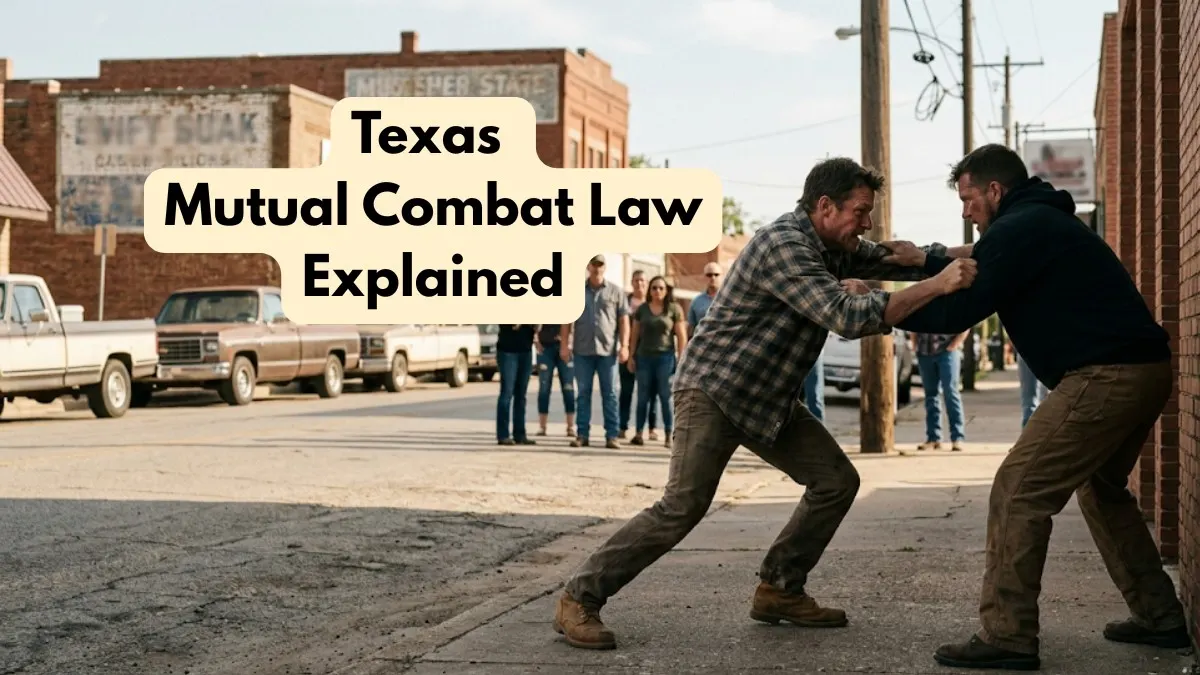
Texas is one of the few states where two people can legally agree to fight each other without automatically committing a criminal offense. The texas mutual combat law draws significant attention online, often misrepresented as a blanket permission to brawl anywhere at any time. The reality is more specific and more limited. This article covers exactly what the law says, where it applies, what it does not protect, and what can still go wrong legally even when both parties consent to a fight.
Texas mutual combat law allows two consenting adults to fight by mutual agreement without criminal penalty, under Texas Penal Code Section 22.06. Police can still intervene, serious injury changes the legal picture, and consent does not protect either party from all criminal liability.
Must Read: Is Lane Splitting Legal in Texas?
What Is Texas Mutual Combat Law
Texas mutual combat law is not a standalone statute with that name. It derives primarily from Texas Penal Code Section 22.06, which addresses consent as a defense to certain assault charges. The law recognises that when two adults voluntarily agree to engage in a physical altercation, the element of non-consent that typically defines criminal assault may be absent.
Texas Penal Code Section 22.06 states that a victim’s effective consent is a defense to assault under Sections 22.01 (assault) and 22.02 (aggravated assault) if:
- The conduct did not threaten or inflict serious bodily injury, or
- The victim knew the conduct was a risk of a recognised sport or occupation
This provision is the foundation of what people refer to as texas mutual combat law. It is a defense available in court, not a pre-authorisation to fight freely. The distinction matters enormously in practice.
The Legal Basis: Texas Penal Code Section 22.06
Texas Penal Code Section 22.06 reads, in relevant part, that consent is a defense to prosecution if the conduct did not threaten or inflict serious bodily injury and the victim was aware that his or her conduct constituted participation in a recognized sport or activity.
Courts and legal scholars interpret this to mean that two people can agree to a fistfight and neither party has committed criminal assault against the other, provided:
- Both parties genuinely and voluntarily consented
- No serious bodily injury resulted
- No weapons were used that escalate the conduct beyond what was consented to
- The fight did not endanger bystanders or the public
Texas mutual combat law does not appear as a separate chapter. It operates through this consent defense combined with the broader framework of Texas assault law.
What Texas Law Defines as Serious Bodily Injury
The phrase “serious bodily injury” is the critical boundary in texas mutual combat law. Texas Penal Code Section 1.07(a)(46) defines serious bodily injury as:
“Bodily injury that creates a substantial risk of death or that causes death, serious permanent disfigurement, or protracted loss or impairment of the function of any bodily organ or limb.”
If a fight that both parties agreed to results in serious bodily injury as defined here, the consent defense weakens significantly. The person who inflicted the injury can still face criminal charges for aggravated assault even if the other party agreed to the fight initially.
Examples of injuries that cross into serious bodily injury territory:
- Broken bones, depending on severity and location
- Loss of consciousness from head trauma
- Eye injuries that impair vision
- Internal organ damage
- Injuries requiring emergency surgery
- Permanent scarring to the face
Bruises, minor cuts, and typical fistfight injuries generally do not meet the serious bodily injury threshold. However, this determination is made by prosecutors, judges, and ultimately juries, not by the parties to the fight.
Also Read: How Much Does Surrogacy Cost With Insurance in Texas
How Texas Mutual Combat Law Compares to Other States
| State | Mutual Combat Legal Status | Notes |
|---|---|---|
| Texas | Permitted under consent defense | Penal Code 22.06 |
| Washington | Permitted in some jurisdictions | Seattle historically allowed officer-supervised fights |
| Virginia | Permitted under common law in some cases | Rarely invoked |
| California | Not permitted | Mutual consent is not a defense to assault |
| Florida | Not permitted | Self-defense statutes do not cover mutual combat |
| New York | Not permitted | Assault charges apply regardless of consent |
| Colorado | Not permitted | Mutual combat not recognised as a defense |
Texas is notably more permissive than most states on this issue. The combination of the consent defense in the Penal Code and Texas’s broader culture of personal responsibility creates a legal environment where mutual combat occupies a distinct space.
What Texas Mutual Combat Law Does Not Protect
Understanding the limits of texas mutual combat law is as important as understanding what it allows. The law does not provide blanket protection for fights.
Weapons Change Everything
If either party introduces a weapon into a mutually agreed fight, the consent defense does not apply to injuries caused by that weapon. Using a knife, firearm, brass knuckles, or any object as a weapon during a mutual combat situation escalates the charges available to prosecutors. A fight that starts as mutual combat can become aggravated assault with a deadly weapon once a weapon appears, regardless of initial consent.
Serious Injury Removes the Defense
As covered above, if the fight results in serious bodily injury, the party who inflicted it faces potential aggravated assault charges. Initial consent does not override the outcome. Texas courts have consistently held that people cannot consent to serious bodily harm in the way they can consent to ordinary physical contact in a fight.
Third Party Injuries Are Never Covered
If bystanders are injured during a mutual combat situation, neither party has any defense based on their consent to fight each other. Injuries to third parties expose both fighters to full criminal liability and civil liability. This is one of the most important practical limits on texas mutual combat law.
Public Disturbance and Breach of Peace
Even if no one is seriously injured and both parties consented, law enforcement retains authority to intervene and charge participants with disorderly conduct under Texas Penal Code Section 42.01. A fight in a public place can constitute a breach of the peace regardless of consent between the parties.
Disorderly conduct related to fighting in Texas is a Class C misdemeanor punishable by a fine of up to $500. This is a separate and independent charge from assault, and the consent defense does not apply to disorderly conduct charges.
Police Can Still Intervene and Arrest
Texas mutual combat law does not prevent police officers from intervening in a fight, separating the parties, or making arrests. Officers have broad discretion to respond to public disturbances. If officers witness a fight, they can detain both parties, investigate, and charge them with whatever offenses the evidence supports.
The consent defense is raised in court after charges are filed. It does not prevent arrest or prosecution.
Where Texas Mutual Combat Can and Cannot Occur
Location affects how texas mutual combat law applies in practice.
Private property: A mutual combat fight on private property, away from public view, with property owner consent, creates the fewest complications. The disorderly conduct and public disturbance elements are harder to establish. This is the context where texas mutual combat law operates most cleanly.
Public spaces: Fighting in public, even with mutual consent, risks disorderly conduct charges and police intervention. The more visible and disruptive the fight, the more likely law enforcement involvement becomes.
Bars and licensed premises: Texas Alcoholic Beverage Commission rules and individual liquor licenses create additional legal exposure for fights on licensed premises. A bar owner can face liability if a fight occurs on their property, which creates incentives for establishments to involve police rather than allow fights to conclude.
Schools and government property: Fighting on school grounds or government property carries additional legal exposure for all parties regardless of consent.
Civil Liability Under Texas Mutual Combat Law
Criminal law and civil law operate independently. Even if criminal charges are not filed or are dismissed on consent grounds, either party to a mutual combat fight can sue the other for civil damages in Texas court.
Texas civil courts apply a different standard than criminal courts. The question in a civil personal injury case is not whether a crime occurred but whether one party negligently or intentionally caused harm to the other. Consent is a defense in civil cases too, but it is not absolute.
Texas also applies a doctrine called contributory negligence. If both parties contributed to the situation that caused injury, damages can be apportioned between them. A plaintiff who agreed to fight and was injured may recover reduced damages based on their percentage of fault.
The practical lesson: texas mutual combat law reduces criminal exposure under specific conditions but does not eliminate civil lawsuit risk.
Also Check: Cost of Cremation in Texas
The Role of Police Discretion in Texas Mutual Combat Situations
Texas law enforcement officers exercise significant discretion when responding to mutual combat situations. Several factors influence how officers handle these calls:
- Severity of injuries. Officers who arrive and find serious injuries are more likely to make arrests and refer the case for prosecution regardless of consent claims.
- Public nature of the fight. A fight on a busy street with a crowd draws more aggressive police response than a private dispute.
- Complaints from witnesses. If bystanders call 911 and complain, officers face more pressure to take action.
- Prior criminal history of participants. Officers check records. Prior assault convictions affect how a mutual combat situation is evaluated.
- Intoxication. If either party is visibly intoxicated, consent becomes legally questionable since intoxicated persons may not be capable of effective consent under Texas law.
- Age of participants. Minors cannot legally consent to a fight under texas mutual combat law. An adult fighting a minor faces criminal liability regardless of any claimed consent.
Practical Scenarios and Legal Outcomes
Understanding how texas mutual combat law applies in practice requires looking at specific fact patterns.
| Scenario | Likely Legal Outcome |
|---|---|
| Two adults agree to fight in a private backyard, minor injuries, no witnesses complain | Low criminal risk, consent defense likely effective |
| Two adults fight outside a bar on a public sidewalk, police called by witnesses | Disorderly conduct charges likely, assault charges possible |
| Agreed fight results in broken nose and orbital fracture | Serious bodily injury threshold potentially met, aggravated assault possible |
| One party pulls a knife during an agreed fistfight | Consent defense does not apply, aggravated assault with deadly weapon likely |
| Adult and 16-year-old agree to fight | Adult faces assault charges, minor cannot legally consent |
| Fight on private property, one party loses consciousness | Serious injury likely, criminal charges possible despite initial consent |
| Bystander injured during a consented fight | Both parties liable criminally and civilly for bystander injuries |
How Defense Attorneys Use Texas Mutual Combat Law
When someone faces assault charges in Texas and mutual consent was present, defense attorneys raise the Section 22.06 consent defense as part of their strategy. This approach works best when:
- Evidence of genuine mutual consent exists, such as verbal agreement witnessed by others or text messages arranging a fight.
- Injuries are limited to ordinary fistfight consequences without serious bodily injury.
- No weapons were involved.
- The fight occurred in a private setting without public disturbance elements.
- Neither party is a minor.
Defense attorneys also use texas mutual combat law arguments to negotiate with prosecutors for reduced charges or dismissal when the evidence of consent is strong. Prosecutors weigh the strength of a consent defense before deciding whether to pursue charges.
What To Do If You Are Involved in a Mutual Combat Situation
If you are involved in a fight and believe texas mutual combat law applies to your situation, several practical steps matter immediately after:
- Do not make statements to police without an attorney. Even if you believe consent was present, statements you make at the scene can be used against you. Ask for an attorney before answering questions.
- Document the consent if possible. If the fight was arranged in advance, preserve any text messages, social media messages, or other communications that show both parties agreed.
- Seek medical attention. If you are injured, get medical care. This documents the nature and severity of your injuries, which matters for both criminal and civil proceedings.
- Identify witnesses. People who witnessed the fight, particularly those who can confirm both parties agreed to it, are valuable for your defense.
- Consult a Texas criminal defense attorney promptly. Texas mutual combat law is a nuanced defense. An experienced criminal defense attorney evaluates whether the defense applies to your specific facts and advises on your best course of action.
- Do not retaliate or continue the confrontation. Any conduct after a fight concludes is evaluated separately. Returning to assault someone after a fight is over is not covered by the mutual combat consent defense.
Frequently Asked Questions
Is mutual combat legal in Texas?
Texas mutual combat law permits two consenting adults to fight without automatic criminal assault charges, under Texas Penal Code Section 22.06. However, police can still intervene, disorderly conduct charges can apply, and serious injuries remove the consent defense. It is legal under specific conditions, not universally.
Can you go to jail for mutual combat in Texas?
Yes. Even under texas mutual combat law, participants can be arrested and charged with disorderly conduct, aggravated assault if serious injury results, or other offenses. Consent is a defense raised in court, not a guarantee against arrest. Outcomes depend on injuries, location, and the specific facts involved.
Do you need a witness for mutual combat in Texas?
No law requires a witness for mutual combat in Texas. However, having witnesses who can confirm both parties genuinely consented strengthens a consent defense significantly if charges are filed. Text messages or other communications arranging the fight also serve as evidence of consent in court.
Does Texas mutual combat law apply if someone gets seriously hurt?
When serious bodily injury results, texas mutual combat law’s consent defense weakens substantially. Texas Penal Code Section 22.06 specifically limits the consent defense to situations that did not threaten or inflict serious bodily injury. Prosecutors can pursue aggravated assault charges even when both parties initially consented.
Can police stop a mutual combat fight in Texas?
Yes. Police retain full authority to intervene in any fight, regardless of consent between the parties. Texas mutual combat law does not restrict law enforcement response. Officers can separate fighters, detain them, investigate, and file charges based on what they observe and the evidence available at the scene.
Does mutual combat consent hold up in civil court in Texas?
Consent is a partial defense in Texas civil court but does not fully protect against personal injury lawsuits. A consenting party who is injured can still sue, with damages potentially reduced based on their share of fault. Texas mutual combat law primarily affects criminal liability, not civil lawsuit exposure.
Conclusion
Texas mutual combat law gives consenting adults a narrow legal space to engage in agreed physical altercations without automatic criminal liability for assault. That space is defined by the absence of serious bodily injury, the absence of weapons, and the genuine voluntary consent of both parties. It does not prevent police intervention, disorderly conduct charges, civil lawsuits, or criminal prosecution when the fight produces serious harm.
Anyone considering relying on texas mutual combat law should consult a Texas criminal defense attorney before acting on general information. The law provides a defense, not a permission slip.







Leave a Comment