
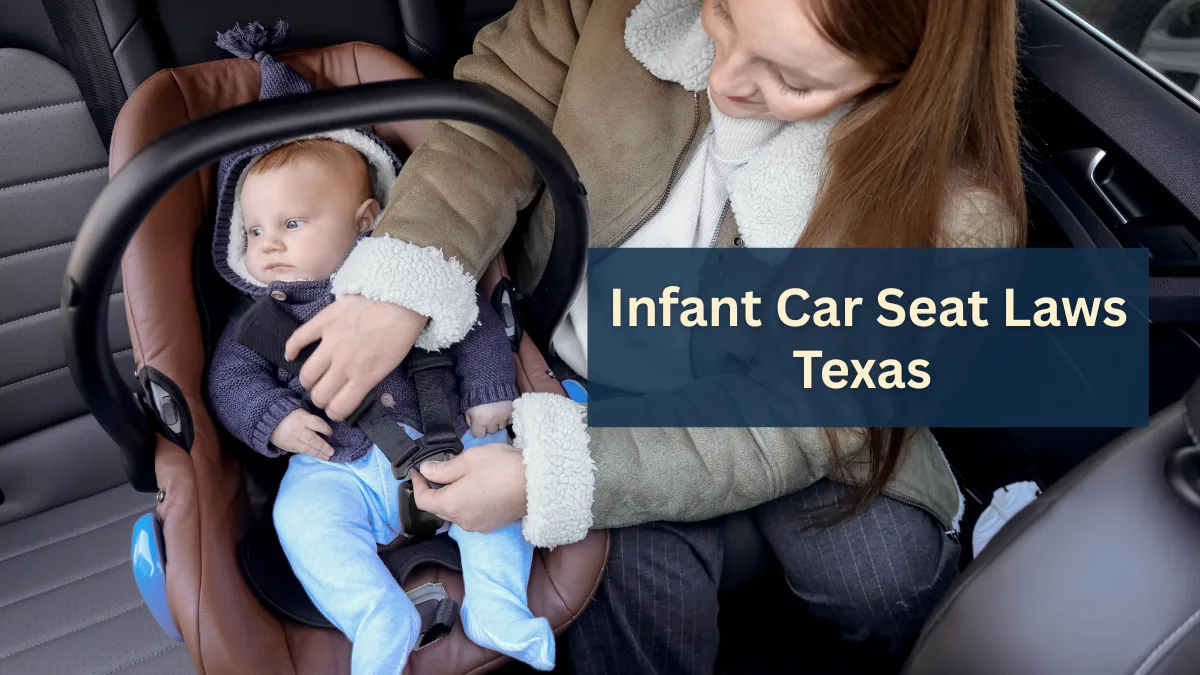
If you are a new parent in Texas, infant car seat laws Texas requirements are one of the first things you need to get right. Getting it wrong is not just a safety risk. It is a criminal offense that carries fines and a mandatory safety course. Texas law sets specific requirements for how infants and children must be restrained in vehicles, and those requirements have layers that trip up even careful parents. This article covers every requirement, explains what the law actually says, breaks down the age and size progression, and tells you what happens if you get it wrong.
Texas infant car seat laws require children under age 8 to be secured in a child safety seat unless they are taller than 4 feet 9 inches. Infants must ride rear-facing until they outgrow the seat’s height and weight limits. Violations carry fines up to $250.
Must Read: Is Texas a No Fault State? Car Accidents, Divorce, and What the Law Says
The Texas Statute: What the Law Actually Says
Infant car seat laws Texas requirements come from Texas Transportation Code Chapter 545, specifically Section 545.412. This statute makes it a misdemeanor offense for the operator of a passenger vehicle to allow a child under age 8 to ride in the vehicle without being secured in a child safety seat system.
The full text of the requirement under Section 545.412:
A person commits an offense if they operate a passenger vehicle, transports a child who is younger than eight years of age, and does not keep the child secured during the operation of the vehicle in a child passenger safety seat system.
The exception: A child who is taller than 4 feet 9 inches is exempt from the child safety seat requirement and may use a standard vehicle safety belt instead.
The penalty: A violation of infant car seat laws Texas is a misdemeanor. The fine runs from a minimum of $25 to a maximum of $250 for a first offense. An additional fee of up to $100 may be assessed, and the court may require the driver to complete a child passenger safety course.
Age and Size Requirements: The Full Progression
Infant car seat laws Texas requirements work through a progression of seat types as a child grows. Each stage has specific criteria.
Stage 1: Rear-Facing Car Seat (Infants and Young Toddlers)
Texas law does not specify an exact age at which a child must remain rear-facing, but the Texas Department of Transportation and the American Academy of Pediatrics both state that children should remain rear-facing until they reach the maximum height or weight limit set by the car seat manufacturer.
Most infant car seats accommodate rear-facing use from birth up to 22 to 35 pounds and heights up to 30 to 35 inches depending on the specific seat. Convertible car seats extend rear-facing limits to 40 to 50 pounds and heights up to 43 to 49 inches.
What the law and safety guidance require for infants:
- All newborns must ride rear-facing from birth
- The rear-facing position must be maintained until the child outgrows the seat’s rear-facing height or weight limit
- The seat must be installed at the correct recline angle (typically 30 to 45 degrees for newborns) to keep the airway open
- The harness must be at or below shoulder level for rear-facing seats
- The harness must be snug with no more than one finger of slack at the chest
Stage 2: Forward-Facing Car Seat with Harness (Toddlers)
Once a child outgrows the rear-facing limits, they transition to a forward-facing seat with an internal harness. Texas law requires children to remain in a child safety seat system until age 8 or until they exceed 4 feet 9 inches in height.
A forward-facing seat with harness should be used until the child outgrows the forward-facing height or weight limit on that specific seat. Most forward-facing seats accommodate children up to 40 to 65 pounds and heights up to 49 to 57 inches.
Requirements for forward-facing seats:
- The harness must be at or above the child’s shoulders
- The chest clip must be at armpit level
- The harness must be snug with no more than one finger of slack
- The seat’s top tether strap should be connected to the vehicle’s tether anchor
Stage 3: Booster Seat (Older Children)
After a child outgrows a forward-facing harness seat, they move to a booster seat that uses the vehicle’s seat belt to restrain them. Texas law still requires this stage for children under 8 who have not yet reached 4 feet 9 inches.
Two types of booster seats:
- High-back booster: Provides head and neck support, recommended when the vehicle seat does not have a headrest
- Backless booster: Used when the vehicle seat provides adequate head support
A child is ready to transition out of a booster seat and use just the vehicle seat belt when the seat belt fits correctly: the lap belt lies flat across the upper thighs (not the stomach), and the shoulder belt crosses the center of the chest and shoulder (not the neck or face).
Stage 4: Seat Belt Only (Age 8 or 4 Feet 9 Inches)
Once a child reaches age 8 or 4 feet 9 inches in height, Texas law permits them to use the vehicle’s standard seat belt without a child safety seat. However, the seat belt must fit correctly. If the seat belt does not fit properly on an 8-year-old, using a booster seat is still the safer choice even though it is no longer legally required.
Texas Car Seat Requirements Summary
| Child’s Age/Size | Required Restraint | Key Requirements |
|---|---|---|
| Newborn to outgrow rear-facing limit | Rear-facing infant or convertible seat | At or below shoulder harness, correct recline angle |
| Outgrown rear-facing to outgrow forward-facing limit | Forward-facing seat with harness | At or above shoulder harness, top tether attached |
| Outgrown forward-facing harness to age 8 or 4’9″ | Belt-positioning booster seat | Correct seat belt fit, lap and shoulder belt |
| Age 8 or taller than 4’9″ | Vehicle seat belt | Lap belt on thighs, shoulder belt on chest |
| All children under 13 | Back seat strongly recommended | Rear seat safer for all children under 13 |
Infant Car Seat Laws Texas: Specific Requirements for Newborns Leaving the Hospital
Texas hospitals are required to confirm that parents have an appropriate car seat before discharging a newborn. This is not a criminal law requirement but a hospital policy requirement aligned with infant car seat laws Texas standards and American Academy of Pediatrics guidelines.
What parents need for a hospital discharge:
- A rear-facing infant car seat or rear-facing convertible seat installed in the vehicle before arrival at the hospital
- The seat must be installed correctly at the proper recline angle
- The harness must be adjusted to fit a newborn (typically the harness slots closest to the shoulders for a rear-facing seat)
- The chest clip must be positioned at armpit level, not at the stomach or neck
Premature infants and low-birth-weight babies may require a car bed rather than a standard car seat. Car beds allow premature infants to lie flat during transport, which is safer for infants who cannot yet maintain their airway in a semi-reclined position. Parents of premature infants should discuss this with the neonatal care team before discharge.
Common Violations of Infant Car Seat Laws Texas
Texas law enforcement issues citations for car seat violations during traffic stops when officers observe children improperly restrained. Common violations include:
- Child seated without any car seat: The most obvious violation and most likely to be cited.
- Child in a forward-facing seat before outgrowing rear-facing limits: Not always visible to officers but a safety issue.
- Harness too loose: Officers may observe a harness that is visibly loose during a traffic stop.
- Booster seat without shoulder belt: Using a booster with only a lap belt (in older vehicles) is a known safety risk.
- Child over age 2 but under 8 in just a seat belt: If the child has not reached 4 feet 9 inches, this is a violation.
- Infant in a forward-facing seat: Placing an infant in a forward-facing seat before they meet the rear-facing weight and height limits violates safety standards even if it may not always result in citation.
- Car seat installed in the front seat with an active airbag: This is not a specific Texas statute violation but is actively dangerous and against federal safety recommendations.
Texas Infant Car Seat Laws and Rideshare Vehicles
Texas law applies to all passenger vehicles, which includes rideshare vehicles like Uber and Lyft. The driver of the vehicle is the person legally responsible under Section 545.412.
Practical implications:
Rideshare companies in Texas are not required to provide car seats. Parents traveling with infants in rideshare vehicles are legally responsible for bringing their own car seat. Rideshare drivers can decline rides from passengers with children who do not have proper car seats.
Uber offers a car seat option in some Texas cities where vehicles with factory-installed car seats are available. This service is not available in all markets, and availability varies.
Penalties for Violating Infant Car Seat Laws Texas
Texas treats car seat violations as a misdemeanor offense, not a civil infraction. The penalty structure under Section 545.412 is:
| Offense Type | Fine Range | Additional Penalties |
|---|---|---|
| First offense | $25 to $250 | Safety course may be required |
| First offense, completed safety course | Fine may be dismissed | Course completion shown to court |
| Subsequent offenses | $25 to $250 per offense | No dismissal option |
The court has discretion to dismiss a first-offense citation if the defendant completes a child passenger safety course. This course teaches correct installation and use of child safety seats and is typically available online or in person through the Texas Department of Transportation.
An important note: the fine is assessed per offense, not per child. If a driver has two children improperly restrained in the same vehicle, they may face two separate citations.
Also Read: Are Switchblades Legal in Texas: What the Law Actually Says
How to Choose the Right Infant Car Seat in Texas
Texas infant car seat laws Texas compliance requires selecting a seat appropriate for your child’s current size and ensuring it is installed correctly. Here is what to look for:
For newborns and infants:
- Infant-only seats: Designed exclusively for rear-facing use, typically from 4 to 22 to 35 pounds. They come with a base that stays in the car and a carrier that clicks in and out. Convenient for small babies.
- Convertible seats: Used rear-facing from birth and convert to forward-facing as the child grows. Higher rear-facing weight limits (up to 40 to 50 pounds) mean the child can stay rear-facing longer.
- All-in-one seats: Transition from rear-facing to forward-facing to booster. The highest price point but may be the only seat needed from birth through the booster stage.
What to check before buying:
- Verify the seat has not expired (most seats have a 6 to 10 year lifespan printed on the shell)
- Check for any recalls at the NHTSA website (nhtsa.gov) using the model number
- Confirm the seat fits in your specific vehicle before purchase if possible
- Ensure the seat fits your child’s current height and weight
- Read the installation instructions for your specific vehicle and seat combination
Car Seat Installation: Getting It Right
A correctly selected car seat that is incorrectly installed provides significantly less protection. Studies by the National Highway Traffic Safety Administration consistently show that a high percentage of car seats are not installed correctly.
Steps for correct rear-facing installation:
- Read both the car seat manual and the vehicle owner’s manual for seat-specific installation guidance
- Choose installation method: LATCH system or vehicle seat belt (not both)
- Install at the correct recline angle per the seat’s built-in angle indicator
- The seat should not move more than one inch side to side or front to back when tested at the belt path
- The harness must be at or below shoulder level for rear-facing
- The chest clip must be at armpit level
- The harness must be snug (pinch test: no excess fabric between fingers at the collarbone)
Free car seat inspection resources in Texas:
Texas has a network of certified Child Passenger Safety (CPS) technicians who provide free car seat inspections. The NHTSA Safe Kids Worldwide locator (nhtsa.gov/child-safety/car-seats) allows Texas parents to find certified inspection stations near them by zip code.
Infant Car Seat Laws Texas and Used Car Seats
Texas law does not specifically prohibit using a secondhand car seat, but safety organizations including the American Academy of Pediatrics strongly caution against it unless you have complete information about the seat’s history.
Do not use a secondhand car seat if:
- The seat has been in a moderate or severe vehicle crash
- The seat has passed its expiration date
- The seat is missing any parts or the manual
- The seat shows visible cracks, fraying harness straps, or missing labels
- You do not know the complete history of the seat
A car seat that has been in a significant crash may have internal structural damage that is not visible but compromises its ability to protect a child in a future crash.
Frequently Asked Questions
What are the infant car seat laws in Texas for rear-facing seats?
Texas infant car seat laws Texas require infants to ride rear-facing until they outgrow the height and weight limits of their rear-facing car seat. There is no specific minimum age for transitioning forward-facing under Texas law. Safety guidance recommends staying rear-facing as long as possible within the seat’s limits.
What is the fine for a car seat violation in Texas?
Violating infant car seat laws Texas carries a fine of $25 to $250 for a first offense under Texas Transportation Code Section 545.412. First-time violators may have the fine dismissed by completing a certified child passenger safety course. Subsequent offenses carry the same fine range without the dismissal option.
At what age can a child stop using a car seat in Texas?
Under infant car seat laws Texas, children must use a child safety seat until they are 8 years old or taller than 4 feet 9 inches. Once either condition is met, the child may use the vehicle’s standard seat belt. The seat belt must fit correctly: lap belt on upper thighs, shoulder belt across chest.
Are car seats required in rideshare vehicles in Texas?
Yes. Texas infant car seat laws apply to all passenger vehicles including rideshare vehicles. The driver of the vehicle is legally responsible under Section 545.412. Rideshare companies are not required to provide car seats. Parents must bring their own. Some Uber markets in Texas offer a car seat option in specific vehicles.
Can you use a secondhand car seat in Texas?
Texas law does not explicitly prohibit secondhand car seats. However, a used seat should never be used if it has been in a crash, is past its expiration date, has missing parts, shows visible damage, or has an unknown history. Car seat expiration dates are printed on the seat shell and typically run 6 to 10 years from manufacture.
Where can I get my car seat inspected for free in Texas?
Texas has certified Child Passenger Safety technicians who provide free car seat inspections at locations across the state. Use the NHTSA Safe Kids inspection station locator at nhtsa.gov/child-safety/car-seats and enter your Texas zip code to find the nearest certified inspection station. Many Texas fire stations and hospitals also offer inspections.
Must Read: Is Texas a Stop and ID State? Your Rights and Legal Obligations Explained
Conclusion
Infant car seat laws Texas requirements protect children from birth through age 8 through a staged system of rear-facing seats, forward-facing harness seats, booster seats, and finally standard seat belts. The law is clear, the penalties are real, and the safety evidence behind the requirements is strong. Install the right seat for your child’s current size, install it correctly, and get it inspected by a certified technician if you have any doubt. That combination keeps your child protected and keeps you on the right side of Texas law.









Leave a Comment