
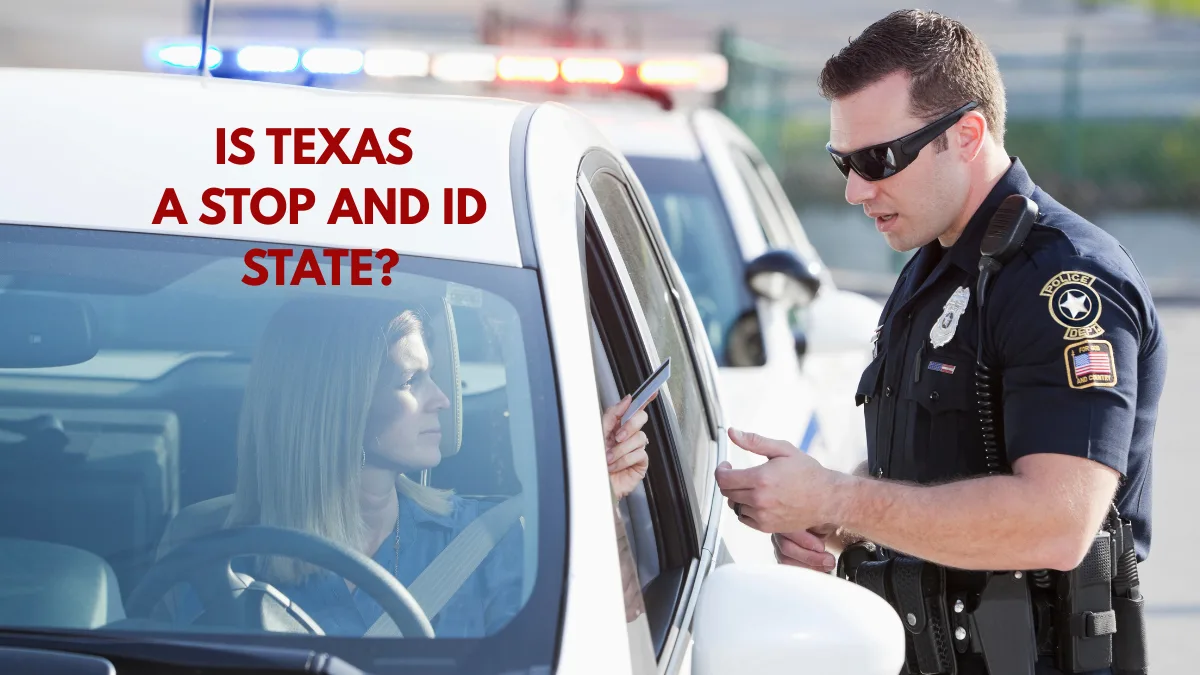
People ask is Texas a stop and ID state because the answer directly affects how they should behave during a police encounter. Getting this wrong can result in a criminal charge that most people had no idea they were risking. Texas does have a stop and identify law, and it carries real legal consequences for non-compliance. This article explains exactly what the law requires, when it applies, what you do not have to provide, how Texas compares to other states, and what your rights are during a police stop.
Yes, Texas is a stop and ID state. Under Texas Penal Code Section 38.02, you must provide your name, date of birth, and residence address to a police officer who lawfully detains you and requests that information. Refusing is a Class C misdemeanor.
Must Read: Are Brass Knuckles Legal in Texas
What Is a Stop and Identity Law
A stop and identify law requires a person who has been lawfully detained by law enforcement to identify themselves upon request. These laws exist in roughly half of U.S. states. They are distinct from laws requiring people to carry identification at all times, which the United States does not have at the federal level.
The key legal framework comes from the U.S. Supreme Court decision in Terry v. Ohio (1968), which established that police can briefly detain a person based on reasonable suspicion of criminal activity, even without probable cause for arrest. States then determine whether a detained person must identify themselves during such a stop.
Is Texas a stop and ID state? Yes. Texas has one of the more clearly written stop and identify statutes in the country, and it has been interpreted and applied in Texas courts over many years.
Texas Stop and ID Law: The Exact Statute
Texas Penal Code Section 38.02 is the stop and identify statute. It states that a person commits an offense if they intentionally refuse to provide their name, date of birth, or residence address to a peace officer who has lawfully stopped them and requested the information.
The full requirements under Section 38.02 are:
- A peace officer must have lawfully stopped (detained) the person
- The officer must request the person’s name, date of birth, and residence address
- The person must provide that information truthfully
- Providing false information is a separate and more serious offense
Section 38.02 offense classifications:
- Refusing to provide name, date of birth, or residence: Class C misdemeanor (fine up to $500)
- Providing a false name, date of birth, or residence: Class B misdemeanor if the person was a witness, Class A misdemeanor if the person was under arrest (up to one year in jail and $4,000 fine)
This makes is Texas a stop and ID state the answer: yes, with specific legal obligations and penalties attached.
What “Lawfully Detained” Means in Texas
The requirement to identify yourself only applies if you have been lawfully detained. This is a critical limitation. An officer cannot randomly demand ID from any person they encounter on the street without any legal basis.
Lawful detention in Texas requires the officer to have reasonable suspicion that criminal activity is occurring, has occurred, or is about to occur. Reasonable suspicion is a lower standard than probable cause but must be based on specific, articulable facts, not a hunch.
Examples of situations that typically create lawful detention:
- You match the description of a suspect in a recent crime in the area
- An officer observes you engaging in behavior consistent with drug activity
- You are near the scene of a crime and the officer has reason to believe you may have information or involvement
- Your behavior or location creates specific articulable suspicion of criminal activity
- You are a driver stopped for a traffic violation (traffic stop = lawful detention)
Examples of situations that do not create lawful detention on their own:
- You are simply walking in a neighborhood
- You are standing near a business without doing anything specific
- An officer wants to ask you questions without any specific suspicion
- You look out of place in an officer’s opinion without other specific factors
If you have not been lawfully detained, the stop and ID obligation under Section 38.02 does not technically apply. However, determining at the scene whether a detention is lawful is extremely difficult and legally risky to contest physically.
Also Read: When Is Crawfish Season in Texas
The Three Things You Must Provide in Texas
When lawfully detained in Texas, Section 38.02 requires you to provide exactly three pieces of information:
- Your name
- Your date of birth
- Your residence address
That is the full extent of the legal requirement. You are not required to produce a physical ID card or driver’s license during a pedestrian stop (as opposed to a traffic stop, which has different rules). You are not required to answer any other questions beyond these three items.
Many people conflate the requirement to provide identifying information with a requirement to show ID. Is Texas a stop and ID state in the sense that you must carry ID? No. You must provide the information verbally. If you do not have ID on your person, that is not itself a violation of Section 38.02.
What You Do Not Have to Do During a Texas Stop
Understanding is Texas a stop and ID state requires equal clarity on what you do not have to do.
You do not have to:
- Answer any questions beyond your name, date of birth, and residence address
- Explain where you are going or where you came from
- Consent to a search of your person or belongings
- Allow police to search your phone
- Explain what you were doing before the stop
- Say anything that could incriminate you
The Fifth Amendment right against self-incrimination protects you from being compelled to answer questions that could lead to criminal charges. Beyond the three identifying facts required under Section 38.02, you can lawfully remain silent.
A clear and calm statement like “I am providing my name, date of birth, and address as required. I am not answering additional questions and I do not consent to a search” communicates your compliance with the stop and ID requirement while preserving your other rights.
Traffic Stops: Different Rules Apply
Traffic stops in Texas operate under a different legal framework than pedestrian stops. During a traffic stop, you are required to provide:
- Driver’s license (physical document, not just verbal information)
- Vehicle registration
- Proof of insurance
These requirements come from the Texas Transportation Code, not Section 38.02. Failing to provide these documents during a traffic stop is a separate offense. A driver who refuses to provide a driver’s license during a traffic stop faces a Class C misdemeanor under Transportation Code Section 521.025.
Passengers in a stopped vehicle are in a different position. Passengers are not required to provide a driver’s license because they are not operating the vehicle. However, if the officer has reasonable suspicion to detain a passenger, the Section 38.02 stop and ID requirement applies to that passenger as well, requiring name, date of birth, and residence address.
Providing False Information: The More Serious Risk
Many people who understand is Texas a stop and ID state focus on the refusal penalty (Class C misdemeanor) without realizing that providing false information is a significantly more serious offense.
If you give a police officer a false name, false date of birth, or false address during a lawful stop, you face:
- Class B misdemeanor if you were a witness (up to 180 days in jail and a $2,000 fine)
- Class A misdemeanor if you were under arrest (up to one year in jail and a $4,000 fine)
This is the most dangerous legal trap in the Texas stop and ID framework. A person who panics and gives a sibling’s name, a slightly wrong birthdate, or a previous address to avoid identification has committed a crime that is significantly more serious than simply refusing to answer.
The correct response if you do not want to provide information is to clearly state you are declining, not to provide false information.
How Texas Stop and ID Law Compares to Other States
Is Texas a stop and ID state compared to its neighbors?
| State | Stop and ID Law | Must Show Physical ID | Refusal Penalty |
|---|---|---|---|
| Texas | Yes | No (verbal OK for pedestrian) | Class C misdemeanor |
| California | No | No | No penalty for refusal |
| Louisiana | Yes | Yes | Misdemeanor |
| Oklahoma | Yes | No | Misdemeanor |
| New Mexico | Yes | No | Petty misdemeanor |
| Arkansas | Yes | No | Fine |
| Colorado | Yes | Yes | Petty offense |
| Florida | Yes | No | Second-degree misdemeanor |
| New York | No | No | No requirement |
| Illinois | Yes | No | Petty offense |
States without stop and ID laws cannot compel you to identify yourself during a detention. In those states, you can legally refuse to provide any identifying information to a detaining officer without criminal penalty. Texas is not one of those states.
Your Rights During a Texas Police Encounter: Step by Step
Knowing is Texas a stop and ID state is most useful when you understand exactly how to handle an actual police encounter in the state.
Step 1: Determine if you are being detained or free to go
You have the right to ask clearly: “Officer, am I being detained or am I free to go?” The officer must answer. If you are free to go, you can leave calmly. If you are being detained, the stop and ID requirement applies.
Step 2: Comply with the identification requirement
Provide your name, date of birth, and residence address clearly and accurately. Do not provide false information under any circumstances.
Step 3: Exercise your right to silence on other questions
Beyond the three required items, you are not legally required to answer additional questions. State calmly that you are exercising your right to remain silent.
Step 4: Do not consent to a search
You are not required to consent to a search. If an officer asks to search your person, bag, or vehicle, you can calmly state: “I do not consent to a search.” This does not prevent the officer from searching if they have legal grounds, but it preserves your legal rights.
Step 5: Do not physically resist
Even if a stop is unlawful, physically resisting a police officer in Texas is a criminal offense under Texas Penal Code Section 38.03 (resisting arrest, search, or transportation). Contest the legality of a stop through legal channels, not physical resistance.
Step 6: Document the encounter if possible
You have the right to record police encounters in Texas in public spaces. Recording preserves evidence of what was said and done during the stop.
What Happens if You Refuse to Identify in Texas
When is Texas a stop and ID state most consequential? When someone refuses to provide their name, date of birth, or address after being lawfully detained.
The sequence typically goes:
- Officer requests identifying information after lawfully detaining the person
- Person refuses to provide name, date of birth, or address
- Officer can arrest the person for the Class C misdemeanor of refusing to identify
- Person is taken into custody, identity is established through other means (fingerprints, database checks)
- Person faces a Class C misdemeanor charge with a fine of up to $500
In practice, Texas police officers often use a refusal to identify as a basis for arrest, which then allows them to establish identity through booking procedures. The person who refused to give their name to avoid identification ends up fully identified anyway, with a criminal charge added.
Practical Scenarios Under Texas Stop and ID Law
| Scenario | Legal Obligation | Consequence of Refusal |
|---|---|---|
| Officer detains you while walking, requests ID | Provide name, DOB, address | Class C misdemeanor |
| Officer asks if you know anything about a nearby crime (witness, not detained) | No obligation to answer | None if not detained |
| Traffic stop as driver | Provide license, registration, insurance | Separate traffic code offense |
| Traffic stop as passenger (no separate suspicion) | No ID obligation unless detained | None if not detained |
| Officer asks questions beyond ID after lawful stop | No obligation to answer | None for silence beyond ID |
| You provide false name during stop | Criminal offense | Class B or Class A misdemeanor |
Recent Texas Court Interpretations
Texas courts have consistently upheld Section 38.02 against constitutional challenges. The key legal requirement remains the lawfulness of the initial detention. Courts have overturned convictions where the underlying detention was found to lack reasonable suspicion, because the stop and ID obligation only attaches to a lawful detention.
The practical implication: if you are stopped without legal basis and then charged with refusing to identify, a strong defense exists that the detention itself was unlawful. This is a matter for a defense attorney to argue in court, not for the person to physically resist at the scene.
Frequently Asked Questions
Is Texas a stop and ID state for everyone, including tourists?
Yes. Texas Penal Code Section 38.02 applies to everyone in Texas, including tourists and non-residents. If lawfully detained by a Texas peace officer, any person must provide their name, date of birth, and residence address. Non-residents provide their actual out-of-state home address as their residence.
Do you have to show a physical ID card in Texas when stopped?
No. Texas stop and ID law requires you to provide your name, date of birth, and residence address verbally. It does not require you to produce a physical identification card during a pedestrian stop. Traffic stops have different rules requiring drivers to show a physical driver’s license.
Can police detain you in Texas just to ask for ID?
No. A Texas officer must have reasonable suspicion of criminal activity to lawfully detain you. A detention solely to demand ID without any reasonable suspicion of criminal activity does not create a lawful stop and the Section 38.02 obligation does not apply. You can ask if you are being detained or free to go.
What happens if you give a false name to police in Texas?
Giving a false name, date of birth, or address to a Texas police officer during a lawful stop is a Class B misdemeanor if you were a witness, or a Class A misdemeanor if you were under arrest. These are more serious offenses than simply refusing to identify, which is only a Class C misdemeanor.
Does Texas stop and ID law apply to passengers in cars?
Passengers in a vehicle are not required to provide a driver’s license because they are not driving. However, if a passenger is independently and lawfully detained by the officer, Section 38.02 applies and the passenger must provide their name, date of birth, and address. Mere presence in a stopped vehicle does not automatically create detention.
Can you record a police stop in Texas?
Yes. You have the right to record police encounters in public spaces in Texas. Recording must not physically interfere with police activity. Texas courts and law enforcement agencies have affirmed the right to record. Video and audio recordings preserve evidence of what occurred during a stop and can be critical if you later contest the legality of the detention.
Must Read: Shipping a Car from Texas to Michigan
Conclusion
Is Texas a stop and ID state? Yes, and it has been clearly established under Texas Penal Code Section 38.02 for decades. If a Texas officer lawfully detains you, you must provide your name, date of birth, and residence address. Refusing is a Class C misdemeanor. Providing false information is worse. Beyond those three facts, you have the right to remain silent and decline searches. Knowing this law in advance is the most practical preparation for any Texas police encounter.












Leave a Comment